May 18, 2006
Balls, Appreciation
Balls, Appreciation
I want to funnel spherical objects using only gravity. These objects need to travel from a hopper, through a tube, single file and out the other end. This should be done with a reliable and consistent flow.
The objects I have are consumer versions of your everyday ball-pit balls that you might find in a fast food playground. The balls are made from a thin, blow-molded vinyl. The spheres hold air, with a bit of pressure, that returns the shape of the ball after being pressed but not so much that the ball would deflate and change shape if a hole were poked in it. The diameter of these balls measure at least an inch smaller at 2.5" than the standard ball size and are priced accordingly in multicolored packs of 100.
Funneling solid objects presents some interesting problems as I'll describe through my trials and experiments. The key thing to know is that you have to deal with a fundamental particle size. In the case of sand that size could be well under half a millimeter while in my project it's the 2.5" of the ball diameter. I realize that these experiments will not necessarily apply to other particle shapes but they should translate to other scales. Working in the realm of geometry, it becomes a luxury to be dealing with these near perfect spheres. They act the same way in any orientation to gravity and to their fellow spheres.
Trail 1(foray in funneling)
(fig1)
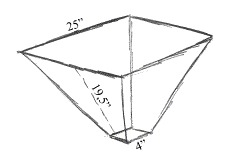
I want to make things easy on my self and use just gravity to funnel the balls. I'd like to avoid moving parts to save on time and effort. Out of cardboard I constructed a hopper made of four flat, trapezoidal planes in the shape of a square-bottomed pyramid with it's top truncated. The long side of the trapezoid measures 25", the short side runs 4" and the trapezoid height comes in at 19.5"(fig1).
I left enough room in the 4" opening for the balls to get through and still be able to run into my 3" diameter tube through a coupling adaptor. That was the idea. I set the funnel on stand for it's first test and dumped all 100 balls in. The first few flowed out nice but soon there after, the group of balls got hung up. They tended to wedge themselves in the funnel so that none could get out. I was able to stick my hand up the chute to dislodge them but promptly they would repeat that which I had just undone. Being the technical whiz I am, my next idea consisted of whacking the funnel on the side to make it work. This and more steady vibration had similar effects as the "hand up the chute" method.
(fig2)
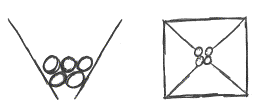
After this, I decided to investigate the nature of the lodging. I did a little excavating of the funnel and found at the bottom four balls holding up the party and a set of nine balls in the same manner just above them (fig2). They would prop themselves up against the side and each other. Sort of like all three stooges trying to get through the door at the same time, I've got to figure out how to make them go one by one.
Roundabout Snatch
When I get the question "Teach me a trick" this is one I pull out. It's quick to learn, looks harder than it is and falls well within most people abilities. Most able-bodied adults and children have a successful attempt in their first five tries. The idea is to hold a ball, or small object in the hand, drop that ball, move your hand in a full circle around the falling ball and snatch it out of the air before it hits the ground.
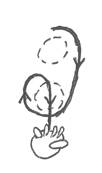
Procedure:
Hold the ball in your hand with your palm facing down. I should pause here. It's a bit deceptive to say "drop the ball" at this point. The drop is not really a drop. You, very slightly, lift the ball as you drop it. This gives some extra time for the move. The easiest move to start with is a circle from inside to out. With the right hand this is a counterclockwise circle and clockwise for the left. After releasing the ball, you drop your hand to the inside, then moving to the outside under the ball. As the ball falls your hand completes the circle and you snatch the ball from the top.
At this point you should be holding the ball the same way you started with. While learning, it is a good idea to keep your body loose as you practice. Bend at the waist a little and flex your knees. It's much easier for your body to follow the ball down in this stance, should you need the extra time.
Variations:
1. Learn to perform both clockwise and counterclockwise circles in each direction.
2. Performing this trick in the left and right hand, in sync, impresses many people.
3. Try for double or triples. Start high and take advantage of the full length of the fall to the ground by doing multiple circles before the snatch
Trial 2 (nine-ball float)
(fig3)
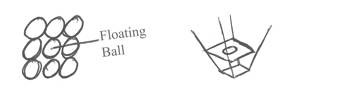
After looking at the structure of the four ball and nine-ball lodgings, it appeared that a key to solving this problem was the floating ball in the center of the nine-ball layout. That ball was not directly subject to the wedging action of the sides of the funnel. I theorized that if I built a platform in the bottom of the funnel just big enough for a nine-ball structure to lay on with a bit of wiggle room, that I could simply cut a ball sized hole in the middle of that platform for the floating ball to flow through. Other balls would come behind it to fill the empty space. That platform needed to be 6.5" square to hold the balls at the right height (fig3).
Just as before, the balls were dumped in to the funnel. The results proved to be much worse. What was I thinking? Sure, just make a smaller opening at the exact right place and the balls will just come flowing out... Several problems presented. First the balls wouldn't always bottom out perfectly into the nine-ball lay. The act of dumping the balls in the funnel is so chaotic that reliably getting that perfect result is out of the question nearly every time. Second, the eight balls that I had expected to stay stationary, to allow the floating ball to fall through, acted very similarly to the walls of the funnel. They created their own mini one ball funnel in the funnel only to become clogged the same way the outer version did.
Elbow Bounce
This trick is something that you've seen a million times. Every father from here to Sheboygan has pulled this one out to impress the kids. It's proven through time as a trick that's easy to learn but hard to master in its subtleties. The trick goes like this: hold a ball while the arm bends at the elbow, then drop the ball while straitening out the arm to hit the ball into the air.
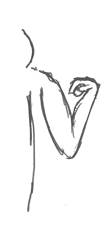
Procedure:
The smaller the person, the lighter a ball I recommend for this. Less force is necessary in the arm straightening to hit a lighter ball hard enough for the trick. Start with a medium weight and adjust as to what feels right for you.
Hold the ball in your hand with your palm facing you. Bend your arm at the elbow towards you, like you are showing off your arm muscles. Don't hold your arm straight out. Lower your upper arm to about 45 degrees in relation to your shoulders. Allow your wrist to droop and hang your hand above the elbow. From this position drop the ball and pop your elbow straight in one motion. As the ball jumps up in the air catch it with the same hand.
It's important to lower your arm out of alignment with your shoulders. Straightening out the elbow from this lowered position gains the most vertical motion from the point of contact with the ball. At first, be careful not to throw your arm out too fast as it can cause some injury to the arm if repeated too often.
Variations:
1. The ball trajectory can be aimed with just little finesse. Hit right on the elbow to throw straight up. Hit on the upper arm to throw away from your body and on the forearm to throw towards.
2. The ball can indefinitely bounce on the elbow with short pops right on the elbow without a catch.
3. By turning the arm a little, the ball can be bounced between your two elbows with no hands involved
4. Reverse the action of the elbow bounce to create an elbow catch by means of holding the ball between the upper and lower arm in the elbow.
Trail 3 (give up but don't go all the way)
(fig4)
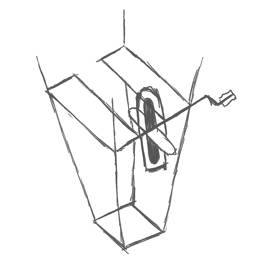
This is where I partially give up on the "gravity only" thing. It left the platform in place but this time I cut out the center third. I knew that wouldn't be enough. We all could have seen that coming. The significant design change was the addition of a paddle wheel acting on about half of that opening (fig4). This introduced a very simple mechanic. The paddle wheel was situated half way in the funnel with a cutout on the side for it to rotate through. The size of the paddles and the cut outs prevented balls form escaping through the side hole.
The paddle wheel functioned as an agitator on the lower part of the group of balls. I experimented with reversing the rotations as well. The results were, again, disappointing. The same type of blockages set themselves up in the funnel. This time, the blockages left just enough room for the paddle wheel to scrape by to no effect. In the attempts that did dislodge balls, they would often get stuck between the paddle wheel and the platform or wall depending on the direction of rotation.
An issue not noticed before was the effects of dampening in this system. A paddle wheel acting on a small set of balls in the funnel had a greater effectiveness in funneling. With the smaller group, the balls had room to move and bounce around. The motion of the wheel was significant enough to move the entire grouping. With the whole test set of 100 balls in the funnel, the upper balls severely dampen the movement of the lower balls. After an initial period of stabilization, the chaotic effect on the system became close to zero. When the paddles could act on the balls, the reaction of the balls was consistent and repeatable due to the dampening. A set of balls would be pushed up as a group kept inline by the rest of the set staying in there relative positions within a grid. This grid seemed to be a function of the size of the balls and the shape of the funnel.
Neck Catch and Return
The Catch
The neck catch makes a great stall, or pause in the middle of a juggling routine. It can also be used singularly as a party trick or a finale to any ball manipulation. Let's talk about how to accomplish this.
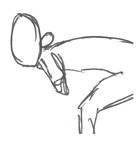
Procedure:
It's best to learn this trick with a ball that has a good amount of give in it. Beanbags or hacky sacks show more forgiveness, as they will resist bouncing off your neck when they land. We'll talk about other considerations for more advanced methods later.
The trick starts with a throw straight up in front of you. This throw should travel in a line about a foot in front of you. A throw straight over your head does not leave any room for the changing position of the neck when you bend over to catch it. You should start with a throw height about two to three feet above your head. The catch can conceivably be completed with a well aimed a throw of any height but it's good to start with the easy control of a short throw.
As you throw, keep your eyes on the ball. Look at the ball until the very last second when the ball is about to hit you. At that moment flick your head down to catch the ball. There are two essentials for a successful catch. First, keep your head facing forward. This creates one side of the pocket that the ball falls into. Second, lift your shoulder blades by throwing your arms out to your sides to create two more sides to the pocket.
The Return
After you get the catch down, you can learn the return. The return is a bit more advanced but is invaluable as a visual counterpoint to the catch. In this, from the neck catch position, the ball rolls down the head and is tossed up and back into your hand or juggling pattern.
Procedure:
This part assumes that you already have a grasp on the catch technique. With this you need to be able to catch and control a ball that holds it's shape better. A stiffer ball makes for an easier roll off the head.
With the ball on your neck, slowly tilt your head down allowing the ball to roll down the center of your head. Just as it reaches the crest on the back of your head, stand up straight and lift up your head. This should flick the ball up into the air just high enough for a simple hand catch. It's important to note that as you lift your upper body and head, you should perform this in one smooth motion, as consecutive events. The back must roll up like a piece of ribbon with the head lagging behind until just the last moment when it whips up to propel the ball. Make sure that the ball stays exactly centered on the head as it rolls up. This takes a lot of practice; otherwise the ball flies off in unpredictable directions.
Variations:
1.From the neck, the ball can be allowed to roll down the back and caught by a well-placed hand between the legs.
2.With practice, the ball's return can be directed straight up to again be caught on the neck.
3.From the neck, the ball can be rolled up the head. With a deft touch, the ball can come to rest balanced on the forehead, having never lost contact with the surface.
Conclusion (what works, what might work, where to look for a solution)
I'd like to say this right at the start, I believe there is no way of gravity only funneling given the conditions that I use; a hopper/funnel to hold the whole set of balls and traveling into a tube single file. There are, however, two things that could be changed to make this work. The first is the addition of mechanics and external movement. I'll discuss this a little later. The second is the expansion of the size of the tube.
I did a little more experimenting. I don't have any hard numbers to back these thoughts up, but when you expand the hole or tube so that nine balls can fit through at the same time, funneling becomes much more reliable. I expect that this comes from the probability for formation of a lodging. If we allow all the eight ball squares (nine-ball pattern minus the floating center ball) to fall through by making a large enough hole, we are left with only 12 ball squares that can act as the basis for a lodging (fig 5). My intuition tells me that these would occur much more rarely, even exponentially so, when compared to four and eight ball squares.
(fig5)
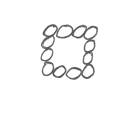
The funnel as it started out, worked better the lower the number of balls in the funnel at a time. With one ball at a time, the system works beautifully. Increasing the number to two, the chances of a lodging increase and so on for larger numbers. The chances of a full, successful funnel of the entire set of 100 is possible but exceedingly small.
At this point you can start looking for alternative answers that get the job done by leaving behind the conditions of the original problem. The simplest of these other solutions is to skip the hopper and funnel in favor of a long preloaded tube. This eliminates the need for any funnel since the ball start in single file.
Another is to take a cue off of a gumball machine. The rotating base allows enough time and agitation for a ball to settle down into place between blades before it drops into the chamber for you to retrieve it from.
Aside (let's drop this funnel)
As an aside, this shape, that the funnel is, makes an excellent object for dropping through air. You can play with it in a manner similar to how you might play with a plastic parachute man. The properties are such that it tends point down in flight. The large end creates enough drag to turn it down. The shape also creates low pressure in the interior of the shape as it wedges though the air. The low pressure, combined with the drag, makes the shape fall slower than you would expect. And finally, the best part: even with the mere 4" measurement of the base, the shape likes to land perfectly on it's end without falling over. Amazing.
I hope this helps
Posted by cliff at 01:38 AM | Comments (0)
January 31, 2006
notes on house movments
As part of my studies of interactive movements, I recently took a tour through my apartment writing down all of the interactive movements that I could find. Here is the list with some preliminary notes:
1. Opening door
2. Turning deadbolt
3. Turning doorknob
4. Turning lock on doorknob
5. Light switch
6. Plug/unplug electrical outlet
7. Mop wringer
8. Iron (dial/buttons)
9. Opening cooler
10. Vacuum
11. Guitar case lock
12. Guitar case handle
13. Guitar case latch
14. Inflatable parrot valve open/close
15. Shoe box lid on/off
16. Zipper up/down
17. Clothes hangers
18. Shirt button
19. Green tub lid on/off
20. Hair dryer button
21. Belt buckle
22. Ac slider control
23. Ac air direction
24. Blinds up/down
25. Blinds open/close
26. Box-light switch on cord
27. Bed springs
28. Clock buttons
29. Small bag cinch (satchel)
30. Opening book
31. Flash light button on end
32. Spray bottle trigger
33. Camera case clip
34. Camera case flap open
35. Jar lid on/off
36. Backpack strap adjustment
37. Key board buttons
38. Hat adjustment on back
39. Toilet lid up/down
40. Toilet flush handle
41. Toilet paper dispenser
42. Shampoo bottle squeeze
43. Unscrew toothpaste cap
44. Adjust shower head
45. Bath faucet on/off
46. Shower curtain open/close
47. Push top hand soap
48. Deodorant click wheel
49. Deodorant cap on/off
50. Pull chain on light
51. Medicine bottle cap
52. Thermostat adjustment wheel
53. Calculator buttons
54. Zip lock bags open/close
55. Dimmer switch turn
56. Microwave buttons
57. Microwave push-latch door open
58. Flip lid on water jug
59. Unfolding paper bag
60. Pepper grinder turning
61. Salt grinder turning
62. Spice lid open
63. Drawer open/close
64. Faucet kitchen on/off
65. Spray hose on/off kitchen faucet
66. Tea powder lid on/off
67. Soup can lid pull tab
68. Cabinet open/close
69. Stove knobs turning
70. Oven door open/close
71. Sport bottle open/close
72. Cheese cutter
73. Pan lids on/off
74. Electrical breaker plug button
75. Fire extinguisher
76. Folding table in kitchen
77. TV antennae moving
78. TV antennae knob
79. Candle lid on/off
80. Surge protector switch
81. Folding chair
82. Lamp height adjustment
83. Lamp turn switch
84. Adjustable arms on couch up/down
85. Air duster trigger
86. Umbrella open/close
87. Moving table on couch
88. Moving kitchen faucet
89. Dimmer switch push
90. Oven clasp
- Just as we ricochet and go past these movements
- These movements are not the goal
- They facilitate the goal
- They facilitate the forward progress
- Maybe I can make the movements the goal
- Bouncing off movements
- Objects as movement nodes
- Places where you go to make movements
- Little defined trails between undefined periods
- A structure of experience
- Movements have defined beginning and end
- They have a finite time that people have a preexisting relation to
- Difference between moving through space (traveling) and interacting with movements (nodes)
- These movements are the intermediaries between our start, our movements, and our goal
- Because they are not the goal, our energies are concentrated past them, even as we are involved with them.
- The way we approach them should reflect this ricochet
- In the interaction, energy is directed past the object. Some goes into the object. Some is directed back into us in the form of resistance.
- Individuals are drawn to these actions, some by nature and some by learning (habituallization)
- These nodes pull the individuals open (Tarzan changing vines)
- In travel people close off (water droplet on non-whetting surface)
- We don't search for the next interaction
- We learn to recognize and take advantage of them as they prove to be the step between our goal and where we are (optimization)
- Goals can be states, contexts. Never just places. Places, alone, are missing the "why" in "why am I here"
- Starting point Node Goal
- Looking at it as a map, diagram, defining paths, optimized paths
- Any number of people can follow in the wake of one person
- The linking of close nodes with conservative motions
- Linking can beget a rhythm
- The linking should be looked at as an aesthetic event
- Interaction of gravitational bodies in space
- These nodes provide the standards in our paths
- They take various input and provide a reliable action, (funnel, panama canal)
- End in the same goal
- These are the movements where we want something out of them other than just the reliable execution of their apparent physical properties and structure
- Nodes define points on a route
- They sometime dictate natural order of the nodes
- They sometime define portions of the route
- The closer one gets to these movements, the more effect the movements (nodes) have on the route
- Environments can be optimized for routes
- Routes can be optimized for environments
- What are the advantages of an optimized route, conservative route?
-- Optimized routes give the best rating for a particular aesthetic while still achieving the goal.
-- The aesthetic can take the form of time, timing, visual, number of nodes, and other personal reasons
-- The conservative route is a particular type of optimization for conservation of motion and flow.
-- In the conservative route, the travel in between nodes affected by the nodes before and after it.
-- The travel seems aware of it's relation to each of these
- How is the idea of conservative movements related to the idea of ricochet?
- Can the interactions be modified to aid the conservation of energy in the travel?
-- The only things that can be modified are the approach and the exit
-- The length of the node is only an instant. It can't be affected.
-- The node happens when the ability is fully activated.
- The approach to the node can influence the exit if the exit is of consequence to the person
- Some attributes of the approach can affect the attributes of the exit due to the amount of energy that is sent past the node
- These movements suggest that order has to be part of every successful goal
- These movements can enforce an order on unordered and semi-ordered approaches and travels (exits?)
- Start Travel (Approach Node Exit ) Travel Goal
- Paths
- Individuals never go through nodes unchanged
-- Nodes are steps in a process.
-- To go through one means to become closer to the goal
-- To go through one means to have left some energy in it and taken some past it
-- A node on the path will affect the path
- Proximity
- Conservative movements relate to flow, grace, conservation of motion
- Who is prone to conservative movements?
- Conservative movements are not harsh, jerky
- Given free reign, do kids make more conservative movements? (less control over body masses)
- Do people need training or instruction to execute conservative movements consciously?
- Body shape influences style of movement
- Is there an optimal range of body sizes that are prone to conservative movements, given standardized material composition?
- Given the idea of people being "open" while at a node, they are vulnerable to an extra-movement event.
- Captive audience at nodes
- The less energy given to the nodes or the less complicated, the less vulnerable the individual is at the node. (to the node?)
- To use the vulnerability in the node, I have to catch them in a real path even if within a manufactured environment
- The node must maintain it's relative status as it would function in a regular instance
- When the node (as an isolated event) is given too much focus it looses it‘s chance to hide behind the individuals preexisting habitualization to it (tolerance)
- ??Most objects are environment, they influence the travel but they don't open you up.
- What is the definition of a node?
-- The node is the object, the place of that object, the ability of that object and the physical movement of it.
-- Movement and outcome in context
- The interaction at a node can but used to trigger other events, but for greater impact, only in addition to the habitualized movements
-- It would be surprising if the shower curtain draws every time you pump soap on to your hands
- "Habitualize" refers to getting use to a movement in a place or context
- "Desensitized" refers to getting used to a movement out of a context other than that of the solely object referential
- Node movements are generic and specific at the same time
-- They are generic as in they subscribe to an evolved standard for their specific type of object
-- They are still specific to the instance they belong (hammers are made used anywhere on anything [not specific], a light switch can be put anywhere but it is meant to be monogamous to one place or instance
- Sometimes that relationship is meant to be in the context of a place (door knob to a door, shower curtain to a shower, and more examples with their locations in their name)
- Sometimes it's meant to be in relation to a greater object (crank on a pepper grinder, any buttons on anything portable, the folding of a chair)
- Why does monogamy matter?
-- That monogamy is what allows us to have a desensitization about them
-- In monogamous instances we get used to the presentation even though situations exist where similar movements, that are not monogamous, still require active awareness
- Defining other objects
- Positive engagement
- If thinking less about movements is a sign of talent for those movements, do investigations of movements make you less talented?
- Dealing with multiple nodes in one path
- Define end of path
- Paths can overlap each other and can be contained within one another
- What happens when nodes directly connect or overlap? (door knob, opening door)
-- Some situations like this should be looked at as a primary example of habitualization of movement.
-- In the example of turning the doorknob with the opening of the door, these two nodes are generally learned together. They fuse in our encounters with them.
-- The travel between the two becomes so short that they practically become one movement.
-- One can gain differing appreciations by looking at them together and by looking at the apart
- People have a natural inclination to desensitize themselves to these movements
- A new movement or a change in the movement can foster an active awareness
- The desensitization process starts with the first encounter with the movement and gains ground with each encounter after
- What is it about the nodes that make them so mutable?
-- Frequency seems to be the most likely cause
-- Also, size might factor in.
-- The range or physical scope of these movements is often smaller than the size of our hands and nearly never larger than the ranger of our arms.
-- The less exertion and travel we put into them the easier they are to ignore.
- How much can I get people to ignore?
- How much deformation, in the "water droplet" analogy, has to occur before notice is taken?
- Do certain movements have a higher inherent volume, so as it takes less of a change to them for them to become un-muted?
- What happens when the node holds on to you longer than expected/normal?
-- It can discourage you from going through that node, finding an alternate node
-- The extra time and energy given can divert the path
- Many nodes next to each other can breed personal innovation within the execution of the nodes
-- As with many problems, when the path has more pieces and becomes more complicated that encourages consolidation and new paths and approaches to get the same goal
- As in a traditional map the node is a point of information
- It is a specific spot for communication
-- You don't have to try to catch a person.
-- People traveling will regularly come to the nodes
-- Very little aimless wandering (paths with the absence of nodes) actually happens
- The node gives a highlighted, positive definition to a place
- The path is non-specific till a node becomes involved
- If the path becomes the goal, can it also function as a node (it's the journey not the destination)
- The traveling time is insignificant in the context of the goal.
- Goals are a "yes or no" achievement
-- A goal generally dose not consider how long it takes to get to it.
-- Time would only factor into a satisfaction of the process plus that achievement
-- The goal could be achieved with out satisfaction when you take stock of the whole process
-- A goal influences how it gets achieved but does not care or make any strict definition on the way it is achieved
-- The more strict the definition of the goal the more strict the manner of achievement becomes
- The series of nodes is what matters
- The node define the path and influence traveling
- Given a goal, there may be multiple paths to take.
- A combination of nodes maybe be equal to a single node, they may have the same output; in the form of a goal or a step to a goal
- Nodes are singular instances not influenced in the action or process by any outside force (the person on the path or the path leading to and way from them)
-- Nodes do not change by how you approach them.
-- They are just blocks to be placed, wholly, in a path
- A person can choose to travel through or not though any particular node
- This is the only way by which free will is expressed in the paths.
- To switch to another node has bearing on the path and the satisfaction of the goal.
- The nodes are indifferent as to whether they are used or not
- The nodes are not benefited from being used
- Nodes provide access to the rest of the path.
- Is an opening action and a closing action the same thing?
-- The node is the object, the place of that object, the ability of that object and the physical movement of it.
-- If any one of the attributes changes that constitutes another node.
-- Opening the door and closing the door are two different nodes. While often linked together (they certainly have a specific order) they can be used separately without the immediate action of the other.
-- Open/close, on/off, up/down Sister Nodes
-- When mapping these would be treated as separate nodes
-- When studying the node by its self, it becomes prudent to study both at the same time.
-- Studying both can give further insights into the function of the mechanism behind the movement that sometimes maybe be obscured
-- In the case of the light switch the fulcrum of the movement and most of the pieces that make up the subtleties of the swing, and positive engagement are hidden from view.
-- There are similar issues brought up with nodes that are made up of multiple movements such as in the case of the basic chop-style wire cheese cutter (#72)
-- Here a movement very similar to that of the light switch happens.
-- For the ability to happen, the two movements (up and down) have to happen.
-- They do not have to happen at a set every time but over any number of performances the number of "up's" will never be more than the number of "down's" +/- 1.
-- This givers them a very special relationship. They are always going to happen together in a route to a goal. They must be treated as one.
- Most of the movements on the list allow for a secondary action of opening or closing something (physical or electrical) 67/90
-- In these, I'd like to propose, more energy is directed past the node rather than into it.
-- The more important outcome is that of the secondary one. (You turn the faucet knob, which opens a valve, which lets the water through. The water moving is normally the event in the chain of the greatest priority.)
-- This has much to do with the middle event being hidden
-- A standard thought might be "you turn on the faucet and the water comes out." Leaving out the intervening mechanics.
- For some the secondary action is one of regulation of movement such as the trigger of the spray bottle and the adjustment of the backpack strap. 6/90
- Some bridge the gap between the two providing regulation and full-open/full-close functions such as the turning of the dimmer switch and the cranking of the pepper grinder
- Movement is a multi-sensory experience.
-- It is rooted in touch, proprioception, sight, and balance
- Movement is a basic function of life.
- Movement is a requirement for life.
-- Along with organization, metabolism, growth, adaptation and reproduction
- The visuals of movement are just as important for the person moving as the person watching.
-- Such as smell and taste are intertwined, In my experience so are sight and physical feedback
-- First encounters with a movement are most productive when they include both of these senses.
-- When I encounter a movement for the first time with just one of these the other sneaks it's way in though my imagination and memory
-- Drawing on past experiences I can somewhat accurately predict what a movement would feel like in relation to by body just by seeing it.
-- Likewise, when in a situation where the movement can be felt but not seen, visualization of the mechanism and movement help to get a better grasp on the situation
-- These are most important. To understand a movement you must understand both the visuals and the feelings of it.
- In art the visuals of movement are emphasized over the physical experience.
- In popular culture and religion, physical movement and visuals of it are more intertwined and equally important.
-- Dances are most often meant for performance in front of an audience.
-- Choreographers tend to design from the visual perspective.
-- Dances have to be aware o how they move, when they move and how it looks.
- Visuals cannot be separated from movement.
- Visual imagination is important in movement.
- Movement rarely occurs without some interaction with an object/ supportive physical contact.
-- When we walk we push against the ground to move forward. (Exception: zero G, where to move a body must push against its own inertia)
- Movement is the primary means by which we interact/ live in our environment. (Exception: new advances in electrical, direct brain controlled systems)
- Personal Movement is the combination of natural and human phenomena.
Posted by cliff at 02:37 PM | Comments (1)
January 14, 2005
List of people types to interview
(A running list and notes)
To Interview:
Elderly
Dancers
Physical rehabilitation patients
Professional car drivers
Crane operators
Surgeons
Tourette's syndrome
Sail boaters
Boulder climbers
Tandem gliders
Hang gliders
Jugglers
Roller coaster designers (good sense of dynamics without an actual experience durring design/ pre-computer)
Capoeira (Capoeiras? Capoeiri?)
Sport players
Basketball
Football
Extreme sports
Not:
Pizza tossers (one trick pony, trick not main focus of activity)
Activities for Pure Meditation
Bungee jumpers (great movement, little control)
Regimented activities
Tae Chi (following patterns for meditation/ exercise)
Fly fishermen
Playground kids (good to observe, bad to interview)
Baseball (too segmented for my tastes)
On the fence:
Bowlers
Kite hobbyists
Thing I want in people/activity:
Full control.
Movement as main focus
Intense focus
The zone
Large "body feeling" component
Response to changing situation component
Either a major sense of own body or body connecting with object in a movement
Flow
Any ideas to add?
Posted by cliff at 03:36 PM | Comments (0)
November 19, 2004
not arbitrary
Sometimes it seems like I'm just shotguning all the descisions I make, still. There should be some better-structured way of figuring out what I should do. I would have thought that it would have found me by now. Another helping of science, please.
Posted by cliff at 12:29 PM | Comments (1)
November 17, 2004
some thoughts from seven miles
:. How the participant experience functions is important. The end experience is derived from the function of this piece. There is a difference between the function and the movement that inspired it. The movement that inspired it is a singular event. While having to be experienced in the context of its surroundings, it remains disconnected from its environment. The function of the piece is more than, but still includes, the original movement or a close facsimile. The function exists in a designed environment with a combination of interactive cues followed by an interaction. These cues can be visual, form, and materials, all playing off of instinctual and cultural standards of how to interact with things. Environmental cues can also be used specifically, to prime the awareness of the participant.
:. I evaluate my pieces like experiments. The experiment is a secondary thought in the making of the piece. I do not expect this to be a major feature of the participants' experience. Pieces are the beneficiary of experiments but not a product of them. They don't function as research paper would. They work more like a magazine article as an adapted, easier to read version of a longer set of results.
:. I need to be around science. I need to go to lectures and listen to discussions. I need to soak it in. I need to learn their methodology. I need to understand how scientists come about their ideas. What happens before an experiment is developed? What inspires their hypotheses? What standards to they use in creating tests? I want to learn how they do research. I want to know where prior knowledge is. I want to know their vernacular. I want to know what makes them develop new vernacular. What level of scientist interpretation exists? What level is generally accepted? I want to talk with them about their work. I want to talk with them about my work. I want to know why they do science.
Posted by cliff at 10:12 PM | Comments (0)
October 29, 2004
thoughts on movement
Some true, some true-ish, some things I'm tossing around, lots pretty obvious. Mostly in relation to human movement.
1:. Movement is a multi-sensory experience.
2:. Movement is a basic function of life.
3:. Movement is a requirement for life.
4:. The visuals of movement are just as important for the person moving as the person watching.
5:. In art the visuals of movement are emphasized over the physical experience.
6:. In popular culture and religion, physical movement and visuals of it are more intertwined and equally important.
7:. Visuals cannot be separated from movement.
8:. Visual imagination is important in movement.
9:. Movement rarely occurs without some interaction with an object/ supportive physical contact. (Exception: zero G)
10:. Movement is the primary means by which we interact/ live in our environment. (Exception: new advances in electrical, direct brain controlled systems)
11:. Personal Movement is the combination of natural and human phenomena.
Posted by cliff at 10:31 PM | Comments (0)
September 13, 2004
the temple
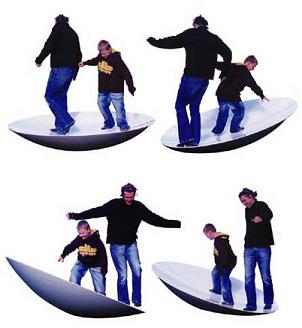
I like this a lot. It seems very close, physically, to what I was doing a year ago. I still have a soft spot for this type of work. When I made it, it posed questions that I couldn't answer. It also abstracted my ideas too much. I wouldn't know how to get my thinking back to something like that and stay in the context of art. I need more training as a designer. Maybe I got into the wrong business. Currently, I make things people climb on and don't get paid. I could make things people climb on with federally imposed safety regulations and getting paid. (hjrstudio.com via Mocoloco)
Posted by cliff at 07:40 AM | Comments (0)
August 14, 2004
notes
Here are some notes out of my sketch book from over the last two months or so. I think a new statment version will be around soon.
- Scientific method
- Science lending rigor of review to art?
- More b+w?
- Study in usability
- Extremes of consciousness
- Feeling intensely
- Transcendental
- Disinterested state
- What blank has to teach me about the world
- Broadening experience
- Human desire to
- Human trait
- Looking for intimacy
- Unlocking potential
- These things don't happen with out interaction
- Nothing but potential till the participant comes along
- Changing the way people interact with their environment
- What interactive benefits?
- Science forces a definition, a consciousness
- I am doing the analysis so the participant can take over and make the last jump into consciousness and evaluation of the subject.
- Don't have to be stuck in the biology imposed, muted environment
- Information/ sensory overload / normal
- Science lending a structure of investigation?
- Fan of movement
Posted by cliff at 05:19 PM | Comments (0)
August 03, 2004
ten
So, to join a crowd for once, I made a list of my ten favorite artists. Theses are the artists that make me happy. And sticking with the format, a one-word description of why i like them follows each. I took the time to order them. Who knows how long this list will stay like this in my head. I'll post a link when the full list of responders gets posted.
1. Martin Puryear. form
2. Arthur Ganson. movement
3. Anne Hamilton. sensibility
4. Richard Serra. physics
5. Tom Friedman. repetition
6. Mowry Baden. feelings
7. Chris Burden. science
8. Rebecca Horn. body
9. Jean Tinguely. manly
10. Sarah Sze. eye
Update: The list of other lists like this is up.
Posted by cliff at 11:06 PM | Comments (0)
July 27, 2004
hangers
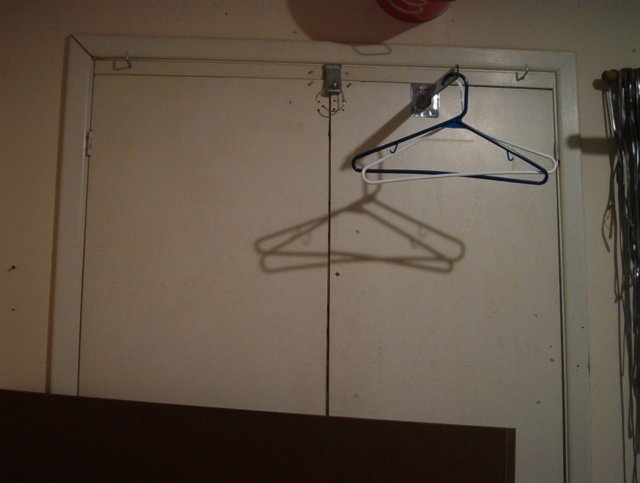
Some times something will catch my eye when I'm sitting around for whatever reason. Sometimes this happens in a place that I frequent enough that my head starts making studies of it. I phrase it like that because it usually takes several instances of fixation before it registers on some lasting conscious level. This particular situation sits directly across the room from me while I'm lying in bed. These two clothes hangers are hooked on some sort of rod attached to one of my closet doors. I think a lot about the way the are intertwined. I play around with them in my spatial imagination from across the room. I wonder if they can be separated without changing the flat plains they both lie in. How do they interact as physical bodies with the two unique anchor points they have. I think about how their shapes, combined with the changing point of contact on the rod, affect their center of balance and momentum direction in certain situations.
These little things never catch my attention for long at any one time, but they keep coming back. I never seem to want to test out any of these things. The answer isn't the fun part. The potential of these objects becomes the inherent value. They sit there. I'm satisfied with out an end product. I don't think many people are.
Posted by cliff at 01:33 AM | Comments (0)
July 13, 2004
thinking about interpretation
Despite my best efforts, I still don't feel like I get "art". I read a lot about it. I have a pretty good idea of the happenings in the art world. I go see art. I see some of the things I read about. What really seems to stick in my head is the disconnection that exists between what I perceive in works of art and the intentions/ perceptions of other viewers. I don't refer to my own art. For this I'm concerned with going and seeing art or facsimile thereof in a publication with little prior knowledge of the information surrounding piece. This separation occurs mostly in the context of critical writing and review.
I don't seem to have any trouble wrapping my head around concepts. On a usual basis, I can correlate how these detailed descriptions and interpretations show up in a work of art. While I get what they say, these are not things that would come into my head without any guidance. It seems that my interpretive abilities, when it comes to other people's art, don't play out very well in language. I find this very frustrating.
When I respond to a work of art, it tends to come upon me as a basic level knowledge. This is to say that, I have a good sense of how a work plays off of my instincts and how it fits in with my favorite, unconscious set of art-evaluating rules. I believe that this is a key to reaching a larger audience with your message.
This prose format is getting to me......
Getting your message to register on the unconscious set .
If message can do that or not.
I get artists like Friedman (1) (2), Serra (1) (2), Rothko (1) (2)
Because something about these works of art line up with my body
But I dont see how some can keep going in their line of questioning
History of searching for the universal in art
But universal way of presenting this particular information
Some people are just looking too hard
Common person looking for the narrative or representation
Need to approach it like viewing a sunset
For the experience rather than the object initially
What happens to me as an artist if I don't have this ability that on the surface other artists seem to have?
Do they have it?
Can I develop it?
Is it already there and just interpreting unconscious into language?
Do I worry too much?
Posted by cliff at 05:12 AM | Comments (2)
July 07, 2004
Things I don't know
(unedited from inside the front cover of my sketchbook)
a. What am I allowed to do as an artist?
b. What my place is.
c. What basic set of questions should I be able to answer about one of my works?
d. How do I know when the amount of thinking I've done about a work is enough?
e. How do I compare to other artists?
f. How do I transfer these basic level feelings that inspire my work, over to my audience?
g. Is that basic, primary knowledge enough?
h. What specifics am I furthering with my art?
i. What purpose am I looking for my art to fulfill that will satisfy me?
j. What amount of documentation of thought should accompany each piece?
k. Do I need theories?
l. If I don't have some of these now does it make me less of an artist if they hadn't come naturally?
m. Why does art function?
n. Does art matter?
o. What qualifies as a statement/ reason/ inspiration for making art?
p. How can works be compared in quality if they have different genres of statements?
q. How does what I'm doing compare to what other artists are doing?
r. Can artists still justify saying that all the audience needs to know is in the piece?
s. Who am I looking to satisfy beyond myself?
Posted by cliff at 03:35 PM | Comments (0)
March 16, 2004
control etc.
I interviewed at The School of the Art Institute of Chicago on March 6th. One of the things that the interviewers asked of me was "What role does control play in your work?" Somehow, this seemed like the biggest question that I got. I didn't have an answer. I think back about what people have thought about my work and I see the issue of control being brought up again and again. I've never formally addressed it though. I want to now.
It's hard to start off. When I first approached this question, most of the answers I could see coming were all psychoanalytical of myself. I felt uncomfortable with this. I like to put some of myself in my work but I see no need or requirement to go that deep with these particular topics. If I'm a control freak and don't know it, I don't want people to feel they figured that out from just viewing my work. In my work, I use control to provide a narrow focus on a particular movement. I find that when taken in the context of the materials I use, these movements provide for good examples of the types of movements I want people to notice more in their everyday lives. I have, in the past, taken commonly available materials and used them to set up these controlled situations. I use these because they are common and therefor more approachable for my participants. They hint at the possibility that this situation is not isolated to the gallery setting. Recently, I've taken that a step further and started using common objects, modified only to a small degree or not at all, to further the implications for beyond the initial interaction. That's the case with my fork piece; Meditation on Movement: Compressed, Release.
Small example situations can represent what might be found in the uncontrolled environment. My situations do not need to represent specific things you will come across in your daily life. They represent a genre of little movements that I want people to notice and appreciate more. I do cull them from genuine, non-manufactured experiences that I have had and noticed. I morph an inspiration movement into something that is surrounded by devices that help get it across better. Sometimes it seems like these other things get in the way and detract from the experience.
So I put these things out. I make them approachable. I try to I provide things that will lead you to the experience. That's about it. Many of my works have endings but no conclusions, so far. I don't know how I feel about that. One thing I haven't done yet is figure out how to tie up the loose ends of what people are supposed to get out of one of my works. If I don't specifically tell them what to think, what can I do? Do I set up some sort of reward that's linked to them noticing something specific? I don't even know how to do that. I need some non-direct statement of my thesis. That would make a clear differentiation between it being an activity and it being art.
I think I want to create more built in periods of participant self-reflection into the scenario of a piece. I want to cut out the hype and see what happens. These reasons make up the basis for what I'm doing with the performance piece. I hope I can manage to make myself do it. In this piece, it might be that I'm trading in visual cues and other devices for more participation from me. It feels like refinement. I won't know for sure till I start hearing second hand reactions.
I don't know if I need to be more specific in my works. I just want to give an experience that adds to their personal vocabulary of movement. I'm not looking for large changes. In the best case scenario I give them a spark that helps them to notice things better. Maybe they notice it, maybe they don't. I at least want them to think about this individual experience that I have just given them. I just want them to have an opportunity to analyze it. They might only figure what I am trying to accomplish (the participant in more personal situations being able notice and analyze movement better) over the scale of several pieces. That's ok with me.
Posted by cliff at 11:08 PM | Comments (0)
February 26, 2004
work in progress
For one of the shows I have coming up in April, I think I might do my first performance piece. It's not so much a performance, as it's just taking the next step in the progression of complex instructions and situations that I create for participants interact with. I plan on becoming part of my work. I seem to be skipping the step of becoming an operator. As that, I would function as an initial facilitator in these situations and let the participants experience the work with no more input from me. I thought that might be a middle ground before becoming fully part of my piece. If I can get past the anxiety in my head, I will take the higher role of a coach.
In a large gallery, the group show will be held. The space is fairly open and most pieces will be wall based. As the crowd of people mingle and view the work, I will watch. I'm looking for somebody I'll feel comfortable with, someone who, on the surface, looks like they could go with the flow. Stranger, or acquaintance; it doesn't matter. Dressed in no special outfit, I will walk silently through the crowd. I approach my chosen participant and ask essentially "Excuse me. I was wondering if I might be able to show you something, teach you something for a minute?" In my hands, I hold a chair. This chair appears just as any ordinary chair. It lives up fully to its appearances. The only thing I require of my chair is that it be much like a typical kitchen chair, with the vertical supports of the back extending individually above where the horizontal element ends. I need that extra length of post or knob to do the action.
I wish to teach them a trick, a motion, something you can do with a chair. To get the action you have to tilt the chair up on to one of the front feet. You hold the chair from falling by placing your palm on the top knob that's on the opposite side (L,R) from the foot on the ground. You then have the chair in a very dynamic position. Your palm sits directly above the foot on the ground. Just by moving your hand in relation to the chair's center of balance, you can make the chair spin. It does not necessitate any twisting, rotation, or assistance from your other hand. When you get good, you can literally hold your palm completely flat and keep the chair under control just by the tilt of your hand. It's very important to be aware of how the weigh shifts to spin the chair. Higher rpm's come from practice.
To share this with people takes that level of participation that I'm not used to. The action dictates that I be there. Written instruction would not be universal enough for this complex situation. As I'm teaching this, I always watch. I observe the progress, what mistakes are being made, what goes well. The action is not hard to do. As they progress, I stay aware of my immediate surroundings. With my participant, I watch for that one moment, that one spark in their eyes that tells me that they got it. They feel the weight. They can spin it at unforced will , now. At that moment, with a snatch, I take my chair and run away.
The effect is to leave faster than they can process the sequence of events. There is no slow let down. This gives them a trigger, in their mind, for a snap shot of this moment and the previous experience. This will lead to future contemplation. This will lead to the participant wanting to go some degree beyond that level of learning by trying the spin at another time, in their own environment.
This motion may seem simple, like everyone can do it. Why do this particular action? There's nothing specific to that action, other than I respond to it intuitively. I've been spinning chairs longer than I've called myself an artist. It's a level of comfort coming from a deep study. I know this movement. I want to raise people's awareness and understanding of movement. I liken it to teaching art at basic levels. The goal of finger painting for first graders has nothing to do with doing it right or completely. Any exposure to the processes of art increases your visual vocabulary and ability. It helps to change what you see at the logical and intuitive level. You start to notice details, relationships, and feelings you haven't experienced before. This is what I want for my participants. I want to give them something that, while not life changing, adds to at least a small degree, to how they can appreciate movement. By studying how my prescribed actions take place and how they are interpreted in full play, I gather more knowledge that aids in my own appreciation of the minutia of the movements around me. Blah blah blah the world is a better place if you just look for it.
Posted by cliff at 03:24 AM | Comments (0)
February 24, 2004
short sketch of future piece
Meditation on Movement: Eccentric Rotation
Form:
Small box of questionable dimensions. Box , Glue and tack construction, with proportions roughly that of a cigar box, hinged lid, nice hardware. Inside, velvet(-ish) covered, specifically made cushion insert formed to hold one allen wrench (first object) and one socket wrench socket (second object). Instructions on inside of lid.
First draft instructions:
1. Insert the short arm of the first object fully into the six-sided opening of the second.
2. Hold the second object upright, as to allow the first to rotate freely in the opening.
3. Use small stirring actions to twirl the first object around.
4. Count the revolutions. Do only ten more than you ever have before.
5. When done, replace the objects, close the box, come back to it another day.
Surface, decoration and screenprinting:
At the moment the outside should have a line drawing of some sort, echoing a hand carved surface. It should be ornate and the top image should incorporate representations of the individual objects inside. One side might incorporate the title. Prints on all sides but the bottom. Some finish and/or stain. Screenprinted instructions in similar style on the inside of lid but with an eye to readability. One pictogram on inside illustrating the proper holding of the objects, maybe with an arrow to imply movement.
Effect:
When the objects are twirled, they produce a ringing sound. This sound is much like a bicycle bell, tiny ringings in fast succession to create a sustained sound. I find this clears my mind, covers other audible distractions around and gives an audible cue for visual and mental focus. The limitations on rotation count encourage reflection. You might want something more when you can't have it. But this, like other forms of meditation is dependent on self-discipline. Counting focuses attention on the full rotation and hand action of the movement rather than just going for a limit on time, which would have people watching the clock. The instructions ask the participant to come back another day. I want this to get away from the isolated incidents of my previous pieces in some respects. More performances of the meditation by an individual breeds greater knowledge, higher levels of observation, and greater levels of tactile, and kinesthetic acuity. The compact kit form combined with these other characteristics allows the participant to have any level of privacy that they wish. They don't have to be inhibited by feeling as if in a performance. It's all in the wrist, baby. Imagine a stuffy, stereotypical french maitre-de with a thin, pencil line, handlebar mustache. Imagine the mildly insulting hand movement he would make while making that french "hunh-hunh" sound. That's what I want. The movement, not the maitre-de.
Posted by cliff at 03:54 AM | Comments (0)
February 20, 2004
maps vs. instructions
Maps and instructions function very similarly on the surface. They can both show you the way to go. Maps tend to be full of detail. The amount of this detail depends on the map. You may have just the outline of the states in our country. On the other hand, you may have tiny details like place names, roads, rivers, topographical designations, populations, etc. Maps give information with out being terribly limiting on how you use that. While instructions lack this broad base of information, they do provide specificity. They can tell you exactly how to get some place. What they don't have is the spatial relationships of maps. Maps represent where places are compared to other places. This provides an added level of implied detail. Instructions have a potential to become more informative by adding more information and displaying it as physical relationships. The form instruction general take implies nothing but order. Likewise, a map can gain specifics through personalization. A map showing two places with one particular route highlighted moves closer to being instructions.
My preferences are for maps. I'm much more attracted to maps as compact information. I just like the idea of so much information being packed into such a small package. The ways maps hold information is much different from my other favorite information format; books. Maps can imply information through visual components as well as clearly state things. They can also use symbols and colors to abbreviate other facts.
But alas, in my own work, I use instructions. Written directions are much easier to refine for me. Instructions have to be refined to a concise state to be broadly effective over a number of users. Instructions have to take into account the results of unbiased test subjects, not just the mental experiment of the writer's head. Instructions have a set of formal elements (i.e. words, phrasing) that lend themselves to being more easily edited. Mmm, no conclusion.
Posted by cliff at 02:33 AM | Comments (0)
December 03, 2003
selected definitions
1. e-quip-ment n.
*Something with which a person, an organization, or a thing is equipped.
*The qualities or traits that make up the mental and emotional resources of an individual.
*Whatever is used in equipping; necessaries for an expedition or voyage; the collective designation for the articles comprising an outfit; equipage
*An artifact needed for an undertaking or to perform a service
2. ap-pa-rat-us n.
*An appliance or device for a particular purpose
*An integrated group of materials or devices used for a particular purpose
*The totality of means by which a designated function is performed or a specific task executed, as in a system of government.
*A political organization or an underground political movement
*Things provided as means to some end.
*A full collection or set of implements, or utensils, for a given duty, experimental or operative; any complex instrument or appliance, mechanical or chemical, for a specific action or operation; machinery; mechanism.
tool n.
*A device, such as a saw, used to perform or facilitate manual or mechanical work
*Something regarded as necessary to the carrying out of one's occupation or profession
*Something used in the performance of an operation; an instrument
*Any instrument of use or service
*A person used as an instrument by another person
*The means whereby something is accomplished
*The cutting part of a machine
3. in-stru-ment n.
*A means by which something is done; an agency
*A device for recording, measuring, or controlling, especially such a device functioning as part of a control system.
*A writing, as the means of giving formal expression to some act; a writing expressive of some act, contract, process
*A device that requires skill for proper use
4. de-vice n.
*A contrivance or an invention serving a particular purpose, especially a machine used to perform one or more relatively simple tasks
*A technique or means
*A plan or scheme, especially a malign one
*A literary contrivance, such as parallelism or personification, used to achieve a particular effect
*That which is devised, or formed by design; a contrivance; an invention; a project; a scheme; often, a scheme to deceive; a stratagem; an artifice
*An instrumentality invented for a particular purpose
*Something in an artistic work designed to achieve a particular effect
*Any clever (deceptive) maneuver
5. con-triv-ance n.
*The thing contrived, invented, or planned; disposition of parts or causes by design; a scheme; plan; artifice; arrangement.
*The act of devising something
6. ap-pli-ance n.
*A device or instrument designed to perform a specific function, especially an electrical device
7.con-trap-tion n.
*A mechanical device; a gadget.
*A contrivance; a new-fangled device; -- used scornfully
8. en-vi-ron-ment n.
*The circumstances or conditions that surround one; surroundings
*The complex of social and cultural conditions affecting the nature of an individual or community
*The entire set of conditions under which one operates a computer, as it relates to the hardware, operating platform, or operating system
*That which environs or surrounds; surrounding conditions, influences, or forces, by which living forms are influenced and modified in their growth and development
9. sce-nar-i-o n.
*An outline or model of an expected or supposed sequence of events
*A preliminary sketch of the plot, or main incidents, of an opera
10. task n.
*A piece of work assigned or done as part of one's duties
*A function to be performed; an objective
*Labor or study imposed by another, often in a definite quantity or amount.
11. les-son n.
*A period of instruction
*An assignment or exercise in which something is to be learned
*The act or an instance of instructing; teaching
*An experience, example, or observation that imparts beneficial new knowledge or wisdom
12. ex-per-i-ment n.
*A test under controlled conditions that is made to demonstrate a known truth, examine the validity of a hypothesis, or determine the efficacy of something previously untried
*An innovative act or procedure
*To try; to know, perceive, or prove, by trial experience
*A trial or special observation, made to confirm or disprove something doubtful; esp., one under conditions determined by the experimenter; an act or operation undertaken in order to discover some unknown principle or effect, or to test, establish, or illustrate some suggest or known truth; practical test
*The testing of an idea
*The act of conducting a controlled test or investigation
(via dictionary.com)
Posted by cliff at 08:46 PM | Comments (0)
October 30, 2003
3 1/2 weeks left, panic?
I officially have a space over at Boundary hall. I went to go see it today. Right now, you have to travel through a maze of storage to get to it. I plan to go over and rearrange some things this weekend to make the space workable. It must be at least 14x14'. They have some nice rolling partitions over there that I'll use to border my area off from all of the junk back there. The hula piece will go over there. I also got introduced to the new woodshop supervisor for that building. I think his name is Ken. He seemed like someone I could get along with very well. He made some really stupid joke about being born "a broad" as opposed to being born "abroad". I don't remember the set up.
Now that I have the woodshop at my disposal, I'm reexamining what I have going. I might want to go back and start over on my leaning platform piece. Then I would probably put the palm shooter on hold. I can't seem to gauge how much I can get done by the end of the quarter. I'm getting nervous about the end coming up so quickly. I want three done.
I really hope to catch the UPS guy tomorrow when he brings my canvas from Dharma for a last attempt. There are about four things left to do on the wall. I need to install the canvas hangings. I need to figure out where the light switch is for the fluorescent light. I need to resolve the pedal and I need to screen print instructions on it. Here's what I've settled on:
1. You are safe. Keep your arms down at your sides.
2. Place your right foot on the pedal .
3. Press the pedal with some weight.
4. You are safe. Keep your arms down at your sides.
5. Push to reset. Repeat if desired.
After talking with Ms. Susan Quinn and getting an in-progress crit from my class, I plan on making some changes to the palm shooter whenever I decide to work on it again. First I plan on extending the divider to at least cover all of the possible areas to which someone could stretch from the chair. That was a good point brought up by Susan, that a normal person would want to just peek around the side of the divider since it is so easy to do. In crit, Brian brought up that I should enclose the place where the arm rests. This would prevent people from getting curious and just reaching around away from where their hand is supposed to go for the ball to hit it. I also plan on enclosing the back of it with some netting that is easy to see through but still able to catch the balls. I like the idea of them scattering, but I think it'll be better when they are concentrated inside a certain area. This might also help to draw people in. I would hope to have a day's supply on the balls loaded into the shooter so you would only have to reload every night. I've still got to figure out how I want to paint it. I need to get my window fixed.
Posted by cliff at 11:05 PM | Comments (0)
October 27, 2003
palm shooter
I started another piece on Saturday. Like the last one, the wall, it was a quick decision to start. The day started out in an odd mood. It felt like a day to take a trip out to the south side to walk around and think. I went to the bookstore and walked around the mall. I found some cute foam rubber balls at the dollar store. I went to eat at Zaxby's even though I wasn't hungry. They have the best ice in town. It's the same kind you get from the Varsity in Atlanta. I took an old sketchbook in with me to look through while enjoying my beverage. Those foam balls, like the kind they use for the elastic paddle ball game, made me want to figure out a machine that I had had an idea for a week or so earlier. The idea was to present an example of a small movement experience. I just wanted to shoot harmless small objects at people's palms. The palm is the most sensitive part of the body that it is, at first glance, feasible to shoot things at. Maybe I'll do something aimed at the lips one day. Mmm… sounds fun. So, my initial hang-up was that I couldn't come up with a powered way of shooting an object that could be easily repeated with the addition of a cache of projectiles, like a paintball gun. I thought about modifying a nerf ball gun. I doubt the mechanisms would have worked out. They usually require pumping or setting stiff spring. I wanted a trigger that didn't need more than moving a lever or pushing a button. I put aside for a few days until I found those balls.
I came up with a new mechanism while I sat there. It's not new actually. Nothing I come up with could be called completely new, ever, as far as mechanics are concerned. This one works the same way a pitching machine does. A motor with a wheel attached spins over a flat surface. The ball rolls towards the wheel under the power of gravity. The ball gets caught and drawn under the wheel. The wheel squeezes the ball between it and the surface and flings the ball out the other side. Remembering that made the sculpture instantly doable. I needed something to mount everything to. I went to a sad looking Goodwill and couldn't find a table to my liking there. I went to Wal-Mart to see if I could find one there. The only one I liked was too expensive ($30), made out of hardboard (not good to mount to), and colored a pale blue (not the color I wanted). So, I went to Lowes to get supplies to make my own table.
The table is 48x24x31" (LxWxH). I built it very sturdy with exposed tie plates holding everything together. The participant sits at one narrow end of the table. Four inches of the tabletop are exposed in front of him. A 24x24" vertical divider separates him from the rest of the table. A hole is cut in the lower left-hand side of the divider, like a mouse hole. Some graphics or text on the face of the divider instructs the participant to place his left arm through the hole. He sits the heel of his hand on a padded rest on the other side as if he were making a "stop" gesture with his hand about six inches above the surface of the table. The right forearm is to be put on the table, crossing the body to find a trigger of some sort next to where the hole is (not a bob dole reference). All of the mechanisms are separated from the person by this divider. The participant can engage the trigger. This releases one ball down to the motor, which flings it to hit his palm at high velocity. I'm still playing with where I want to shot balls to collect. For the moment, I plan to just have them bounce off the hand and scatter throughout the room. The participant will be able to shoot himself several times.
I want the divider to obscure the view of what is happening. Vision seems to be the best thing to subdue when you are trying to bring out the kinestetics. Through the graphics and seeing the system before sitting down, the participant should be able to visualize how it is working in his mind. The analysis that takes place when you are forced to visualize something provides a wonderful state of mind to start from when first noticing movement. Whenever I think about a movement, I visualize at a macro scale. I'm seeing the shift in orientation of elements, the impacts, and the change in balances. Putting the participant in control facilities this. They will know when to pay attention. There is not an element of searching for what they are supposed to notice. What they notice comes up and smacks them in the palm. The surprise of the first hit can cloud the full experience. Through several shots, a deeper investigation can be made.
Posted by cliff at 03:04 AM | Comments (0)
October 26, 2003
why art? II *
After talking with Susan and doing some thinking of my own, I have a first draft idea answering the question "why?" So, it kind of goes like this:
I believe that learning so many things is not worth it unless you pass it along. You spend your whole life gathering knowledge and there exists so much more potential for that knowledge when you share it with others. I'd like to give something back. I want to spread knowledge. I value all of the experiences that I have had. I've learned many things from them. I pick through them all and bring my best to hand back. I do this in a way unlike any other source. These are things that I learn or apply first hand. I'm not preaching from a textbook. Art provides a unique arena in which to present what fills my head. I have to let other people know in order to give myself the validity to go on.
This idea came about long before I started making art. This has always been the reason I've felt drawn to teaching. I wanted to teach long before I knew I wanted to do art. Only recently, have I realized how that applies to my art. In my art I don't express emotions, I'm not making a comment on anything, no politics exist, I simply teach. The fact is what I want to get across. The things I add beyond that just facilitate the lesson. Why didn't I make this connection before?
*revised 10/30/03
Posted by cliff at 01:08 AM | Comments (0)
October 23, 2003
vestibular system
I've got a strange feeling. Today I got out of class early and had ridden my bike back to my house. I put my bike away and walked into the other room only to promptly think of somewhere else I needed to go. So I rode my bike down to Harris hall to turn in my graduation application. I made a couple of other stops while I was down town and went back to my house. After ten minutes or so, I realized that I needed to return some books to the library, where I am now. I decided to drive my car. I drove down to O-house, where I parked and walked the distance to the library. During my walk I got this slight confused feeling. My head was spinning a little bit and my balance seemed impaired. None of this affected me enough to cause any real concern.
While this is more likely the result of dehydration or a bad diet and exercise, I think it might come from something else. The three different types of transportation movement that I had just experienced had been very different. I experienced each one for at least ten minutes at a time. I also went through them nearly back to back. For a third similarity, I went through very similar parts of town in each, if not the exact same places. My idea is that my body had become acclimated to each one of those movements. The abrupt switch between them may have confused my body. I don't think most people would notice things like this. People ride out to the mall all the time, but you don't see people stumbling out of their cars too often. The only common event I can think of that is similar is getting out of the car after a several hour car trip. The reason why I feel it now is that recently I've become extremely in tune and aware of how my body responds to movement and balance. This constitutes about half of my research for my current work. First hand knowledge is working out quite well for me. This particular event seems to affect my sense of balance the most. That makes the most sense actually. It's probably some sort of residual effect of the liquid that provides you sense of balance in the inner ear. Like the same feeling you get from spinning around in circles and getting dizzy and sick.
Posted by cliff at 02:55 PM | Comments (0)
October 19, 2003
ding
My wall is almost done, or rather, it's at least coming along nicely. I still need to make some decisions about the graphics for it. Here's the plan for the moment. I want to have the graphics/ directions in three parts. The first being a left shoe print with the text "step #1" and "place". The second, on the pedal, a right print will have "step #2" and "press". The last will probably become part of the title "step #3 - push to reset". Place, press, and push, cute. Screen printing it seems like a good option. I want to print out some different options on the computer and get some opinions when the time comes. Michelle and I did stuff tonight. She came over to see the wall. She posed the question as to if I need the graphics at all. My answer at the time was that it might be important for safety to have the left foot placed back away from the wall prior to pressing the pedal with the right. I may be able to get away with just some grip tape on those two surfaces. When you approach it from the back I would think that you would be inclined to step on the back one first just because it's the first thing you come to. That is, only if you knew that they were something to be stepped on. I would still need the directions for " push to reset" somewhere. I want to make sure they read that before they do it. They don't have to know exactly what it means until they have the opportunity to put two and two together, when they realize something happens that can be reset. I might also have to separate that space off and only allow one person in at a time. It might function like my meditation on movement that I did over the summer. The group of waiting participants might have only the sound and the people coming out from which to gather what goes on in the room. That Michelle, she's a thinker. She'll have to come talk more often.
Posted by cliff at 02:04 AM | Comments (0)
October 18, 2003
why art?
I talked with Doris recently about some advisement things. We got to talk about grad school applications and such. One of the main things she wanted me to figure out is why I make/do/like art, because that's a big thing to include in your statement of purpose. The "why art" question. This question makes me a little scared. Before, when asked this, my answer "mainly, because they let me". A lot of that stems from the fact that I can't grasp how the whole idea of how art works. Why would somebody buy art? Why do people care about art? Does it actually matter? I've learned how to make art. I'm pretty good at that for my experience. I like to make things. I like to think. It's fun. So I make art. On top of all of that I get to make up my own rules. Something else that prevents me from figuring this out is that I don't have strong feelings for many things. I also hate being sappy about things. I hear people say that they just " have to make art". That makes me want to puke. Maybe I'm just mad that I can't feel things like that about my own work. Occasionally, I really feel like I'm getting away with something. I don't feel like I'm working hard enough. I get surprised that they let me do this kind of this thing in school. It's all too easy for me. Even when I'm working really hard, it doesn't feel that hard. Shouldn't something be boring sometimes. Maybe I do it for the attention. More to come on this some other day. Crisis?
Posted by cliff at 02:11 AM | Comments (0)
October 15, 2003
excerpts from inside the front cover of my sketchbook
top to bottom. no particular date order:
-www.ecosurfaces.com
-Follow through
-List of kinesthetic enhancements
-Kinesthetic communication
-Kinesthetic experience
-Unspoken argument/agreement
-Silent situations
-Body language
-Operator as guru
-Obstacle course
-Symbolism vs. connotation
-Social lubricant
-Sensory deprivation
-Tara Donovan
-Tom Doyle
-Janine Antoni
-Inherent intelligence of materials
-Feeling more when the body is under tension
-Nonvisual communication in visual fields
-Reference past by keeping visual element
-Visual reduced to gimmick and craft
-You can pay more attention if you're not in control. Passenger seat on a road trip
-Good feeling of conservation of movement
-Flag pole and dirt ramp building
-Sensitive parts of the body
-Anticlimacticism
-Do it again
-Anticipation breed analysis
-Alice Neel
Posted by cliff at 01:47 AM | Comments (0)
October 13, 2003
wall
Today I actually did some work of my own for advanced two. I nearly felt like an artist again. But none of the reasons I hadn't been into working have been fixed. So, we'll see how long this sticks. Susan was encouraging. I made a 12' x4' wall today. Susan and Sarah were kind enough to help me carry it up to the top of the stairs where I'm going to install it. Did I mention how beautiful, nice and on top of that, buff those two are? I'm very thankful to have them both in my life and they keep coming back. That's more than most people.
The wall was for a project I haven't really told anyone about yet. Pretty much, only Sarah and Susan have heard it. I just kind of finalized the idea today. Before then, it wasn't worth hearing. It felt good to just jump right into it. I'll let Deborah in on it on Monday. I got frustrated with my other project and sat down to think a while, and made a quick trip to Lowes. The main subject of it is this wall, 12 feet tall, sitting next to the room wall in the space. The wall sits nearly vertical. A light hangs just above it casting a spot or sheet of light down it. At the bottom you see a left shoe print on the floor about 18 inches away from the wall. The right shoe print is on a pedal that leans up against the wall.
The scenario goes like this. The participant walks up to the wall. He is compelled to place his feet on the designated spots. Looking down at his feet he presses the pedal. What he might have been unaware of is that the wall wasn't attached directly to the other wall behind it. It was actually just barely leaning on it. While he looks at his foot, the wall falls forward. A bell rings above his head. That prompts him to look up just in time to find the wall falling towards him only to be caught by two anchor cables at a certain angle away from the wall. The shock of this is enhanced also by the light. The light now shines behind the wall creating a back lit, more ominous image. The bell also serves as an anticlimactic event. With this large motion happening, the signal that this is taking place is just one ring of a tiny bell. The person could follow some placed instructions and push the wall back to reset it.
The idea is to put the person in a situation where the outcome is not clear. The period of time the person is pressing the pedal is what I'm concerned with foremost. That instant, the feedback you feel, the changing resistance of the pedal constitutes the only foreshadowing of what will happen. The natural focus is at your foot. Because of the pivot point of the wall, that area has the least amount of movement. You may not even notice that the wall has moved until the bell ring. When you look up, what you may or may not have noticed about what was happening becomes magnified. The small movement at the bottom of the wall was a large movement at the top. The wall hovers over you as a shock and makes you take a step back to figure out what just happened. This "event/ analysis" scenario is something that should come naturally. From there, I want to give them an opportunity to reset it and try it again. It's important for validation of how you think it might work.
Posted by cliff at 12:39 AM | Comments (0)
October 10, 2003
if i'm writing about art, i'm not thinking about the bad things: responding to movements
So a lot of my ideas stem directly from my own observations. I constantly play around with things. It's probably just as much a nervous habit than anything else. I'll pick things up and throw them in the air to see how they react. I push things around on an unusual axis to see where their balancing point is. I often come across things I like. I write them down and move on, but to return to them another day. I'm responding intuitively to most of these. I don't know why something in particular catches my eye, but I go with it. It's taken a while just to start figuring out how that process works for me. Initially, I know they just feel right. Most of the movements I enjoy, I like to call "conservative movements." I refer to them this way because they conserve the motion and energy of the movement and usually have soft endings and beginnings. Some common place examples are, for one, an experienced raver doing some of the interesting spinnings with glow-sticks, and another, in some cases, ballroom dancing, particularly the waltz. Those are usually some sort of continuous motions. Another type I've noticed is shorter and has harder starts and stops. These types seem to focus more on balance and weight shifts. A nice one of this type is to take a long board and set one end on the ground, holding the other in your hands. You can then throw your end of the board up to flop the board over. For this, I'm not really interested in the end, the crash part. I'm responding to the control of the throw and the state of limbo when the board is no longer under you control and it might flop over or fall back towards you. I like the idea of extending this limbo as long as possible. To do that simply takes practice and making yourself aware of how the throwing motion feels compared with the results. In theory, in a perfect environment, you could get good enough to throw it just right, to make it balance on end. At that moment, I believe you have kinesthetic enlightenment. It's bound to whack me over the head one of these days.
Posted by cliff at 10:04 PM | Comments (0)
October 07, 2003
if i'm writing about art, i'm not thinking about the bad things: elements of my kinesthetic experiences
If it's not visual communication, and it's not audible communication, and it's not written communication, then what is it?
I'm concerned with the feeling of experiencing my work, not an emotional feeling, but the physical one (though you can't completely separate them, another topic for later perhaps). For the moment, I'll call them kinesthetic experiences (kinesthetic communication?). While the experience is the main subject, the act doesn't stand alone. Several other factors contribute to the outcome. It's possible to remove these other factors and nullify the meaning and leave just the shell of a fun ride. First, these experiences have to happen in the context of a preexisting art setting. I wouldn't take my work out in the middle of a field and expect people to get the meaning. In an art space (i.e. gallery, museum), the participant approaches it already primed to think by being in this environment. I'm not one to trick the audience. I want my art to be approached knowing that it's art. That hints on the next element: approachability and guidance.
Most of my pieces would need to be attended by someone to prep people on how to use them. I've actually found that people are afraid and do too little, rather than unknowingly going too far with an apparatus when they don't know anything about it. These guides can ease some of these fears. They can also guide a mindset. Some of my pieces are merely to be played with, while some have a very specific set of movements to go through. Participants feel better when given permission to play or given, at minimum, an action to start with.
The last element for me is the visual aspect. The visual comes secondary to the action many times. I use this in several ways. Because I know not everyone will get to, or be able to try one of my pieces out for themselves, I consider how the setup and action looks to a viewing audience. You can get a good sense of what my pieces are about just from watching someone else go through the act. However, I want to keep it primarily an interaction, rather than a performance. As it goes, "doing is better than seeing." Another way I use it is to aid the mindset and approachability. These pieces exist in an otherwise blank environment, so their appearance creates much of the feeling of the space on it's own. Lastly, trained as a visual artist, I just have a need to make things pretty. Of course, it's all subjective, but I certainly don't want any aesthetic choices to be overlooked for fear of detracting from the concept.
Posted by cliff at 01:18 AM | Comments (0)
September 21, 2003
movement with consequence
I want people to have a good sense of what I want them to get out of one of my pieces by nothing more than the form, and a scenario. I would like the entire interaction to be implied. The form of the piece should have a commonly discernable relation to the body. The participant should know what to do. I want other "smart" characteristics that will help give the scenario a beginning, middle and end. I working towards getting a completely non-verbal, non-written means of instruction. Right now, things are getting less and less instruction. In some cases it may still be necessary. Most often, I made need just a small set of instructions, to get people started, that would have an ending implied only through what they discover during the interaction. I'm running through some other types of devices that I can use to define the interaction better. For one, I could give them a consequence that is directly affected by a movement I want them to examine. Something I've seen in this vein is a plant that is watered by means of pedaling a stationary bike. In a piece I described earlier I try to use sound, in this way, as a more immediate effect. Also something else I'm playing around with is setting a time limit. Sometimes the consequence that might fit well with movement is too distracting from it. People might get caught up in the goal, or what the affected thing means too much to notice the movement. So, if I set some time limit for the interaction, that will provide for a nice ending. In some cases, I'm thinking that a timer will be set and that will just signal an abrupt end like at halftime at a football game. In other cases it a very similar way, but more indirectly, have a timing mechanism or some sort of counter that stops the consequence that they have been interacting with, like a pay phone call being cut off after your 10 minutes are up. The two aren't that different.
Posted by cliff at 12:06 AM | Comments (0)
September 15, 2003
good humor
During one of my critiques last quarter, Cayewah mentioned some subtle humor she had seen in one of the pieces I created. She then said that maybe I should push that a little bit. She thought the humor made its self more apparent in my writings than in my work. I hadn't ever really thought about it before. When I look back on some of my previous works, it seems that humor existed more in the assignments that weren't something I liked, or something that I had to rush through because of procrastination or some mental block. I think used it when something started to not be fun. It helps to balance me out when the thinking gets too strenuous. So I'm pushing it. The idea is that if I start out with predisposition to mixing humor in there to aid my ideas, then I'll have something to mentally fall back on when things get rough. Plus, I think it will add a smidgen of approachability to it all. I want to get past anything that seems too snooty to have any wide-ranging audience. It feels freer to let that part of my thinking come out more. This should help me from getting too bogged down in the "artiness" of how I think my pieces will be viewed. I think I get caught up sometimes in making sure my work falls well under the art category. This extra layer certainly doesn't move my work out of the art range. So I'm running with it. Just as long as I don't let the funny take over and forget the underlying ideas, I should be fine. I'm going to try some more descriptions of my recent ideas soon
Posted by cliff at 09:32 PM | Comments (0)
positive reinforcement
So I have an idea. I want to create a leaning platform for people to lay on. The platform would only lean in two directions. The person would lie with the pivot traveling the length of their body underneath them. I want to keep them from spreading their legs too far out, so the platform will only be about two feet wide plus outriggers at the top and bottom, so the platform angle doesn't get too steep. Sort of like a giant letter "I." I want the participant to lay on the platform and be able to reach up and hold onto two ropes hanging above them. By using these to pull on, the person should be able to balance themselves over the middle, with only th pivot touching the ground. To help them figure out what I want them to do, I want to use sound as a reward, positive reinforcement type system. They should be wearing a pair of headphones. When balanced over the center, all they will hear is some sort of nice music ( la cucaracha maybe?). When leaning over to the left side a buzz or beep will be in their left ear, with the same happening to the right when leaning on that side. The scenario goes like this. The person lies down on the board and puts on correctly oriented headphones. They might put on some sort of blind fold too. I haven't decided. The person reaches up to grab a rope in each hand a little more than shoulder width apart. The sound could be constantly on or turned on at this point in the process. The participant should know generally that they can lean to one side or the other by pulling on the ropes to shift their weight. So, while trying this out for the first time, they would probably just flop over to the other side. Part of the initial motivation is to see if they can get away from the sound that is coming from that side. But on their way over, they would catch just a brief moment of solace away from the annoying sound in their ear. At this point, they would realize that the way the sound is coming from the headphones relates directly to their position. They would probably notice the same pleasant music (in comparison) again when they figure out how to flip back. Hopefully, like training a dog, the person would then feel compelled to figure out how to keep themselves balanced in the middle. This should provide for my ultimate goal of heightening their awareness of the kinestetics or internals feelings associated with movements.
Posted by cliff at 11:28 AM | Comments (0)